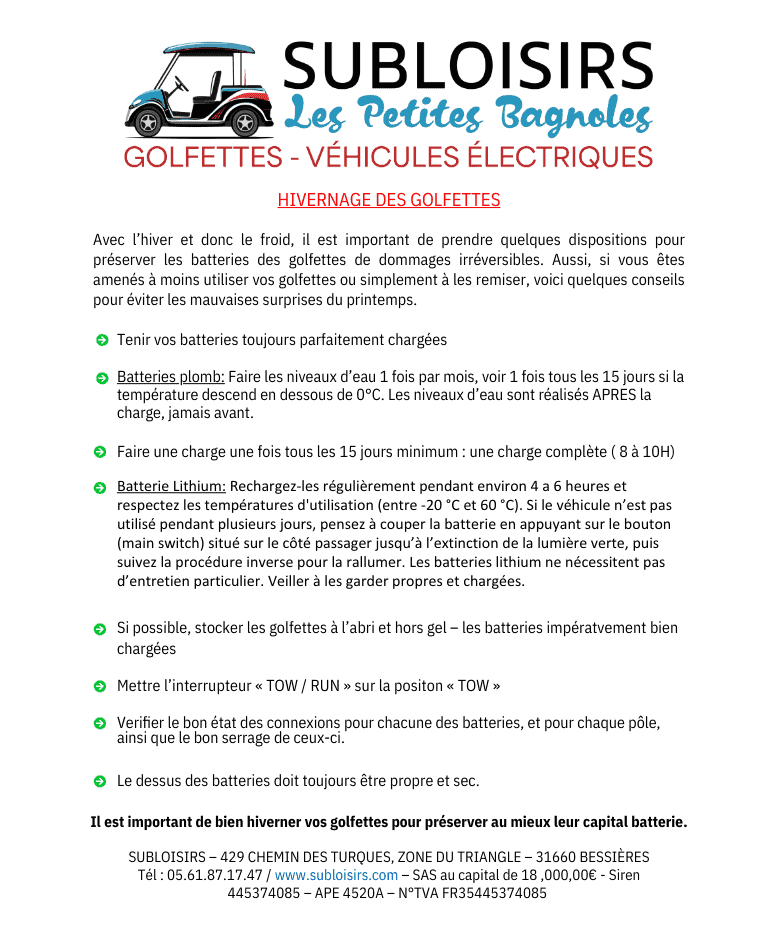
This guide in 30 seconds: Golf carts for tourism professionals
- Average fleet investment €8,000 – €22,000 per vehicle (new, electric, 4 to 6 seats).
- Alternatives : Leasing from €150/month or refurbished used from €3,000.
- Legal obligation : Any golf cart on private land must be insured for civil liability (Art. L211-1 Insurance Code).
- Road homologation : Mandatory if your property is crossed by a public road (category L6e/L7e + registration certificate).
- Seasonal permit : The AM licence is mandatory for any employee born after 1988 driving a light quadricycle L6e.
Managing a campsite, hotel, or leisure park means orchestrating the flow of people and equipment in often vast spaces, with teams whose numbers vary depending on the season. In this context, the golf cart It has evolved from a comfort accessory to a strategic management tool. Customer transport, technical travel, waste collection, accessibility for people with reduced mobility: this compact and quiet vehicle meets a multitude of operational needs that few other vehicles can cover. This comprehensive guide provides all the information you need to make the right choice—from the model itself to the legal framework and acquisition strategy.
Why invest in a fleet of electric golf carts?
The question is no longer whether a fleet of golf carts is useful, but how long you can afford to do without them. Feedback from outdoor hospitality professionals is unanimous: introducing electric golf carts simultaneously improves customer satisfaction, team productivity, and the establishment's brand image.
Customer experience: VIP transport, disabled access and luggage handling
The first contact with a guest arriving laden with luggage after several hours on the road is crucial. A silent electric shuttle picking them up at the entrance and taking them to their accommodation sends a powerful message: you've considered their comfort. For guests with reduced mobility (PRM), a wheelchair is no longer a luxury but a moral obligation—and sometimes a legal requirement under accessibility standards.
Beyond its function as a welcome vehicle, the golf cart is used to organize internal shuttles (pool, restaurant, entertainment), to manage luggage at the beginning and end of stays, and to provide an on-demand transportation service that fosters loyalty among a high-end clientele. Discover the 3 golf cart models best suited for camping for these temporary uses.
Operational efficiency: Housekeeping, maintenance and green spaces
From an operational standpoint, the ROI of a utility vehicle is very tangible. On a 300-pitch campsite, the time saved by cleaning staff, who no longer have to walk back and forth between accommodations, can represent 1 to 2 hours per day per employee. Multiplied by a 120-day season and 4 employees, this amounts to up to 960 hours of productivity recovered.
For maintenance and groundskeeping teams, a cargo model with a loading platform allows them to transport tools, spare parts, and materials without using a passenger vehicle subject to full road regulations. To maximize this use, see our Tips to maximize the use of your golf cart.
Brand image: The eco-friendly and silent advantage
In a tourism sector where environmental labels (Green Key, European Ecolabel) are becoming selection criteria for an increasingly discerning clientele, an electric fleet is a tangible marketing advantage. Zero local emissions, zero noise, zero gasoline fumes: the electric golf cart directly contributes to the quality of the sound environment on your property, which is particularly valued in nature campsites and boutique hotels.
Expert advice: Calculate your ROI before investing. Estimate the cost in man-hours of your current internal travel (time lost on foot or in unsuitable vehicles), then compare it to the monthly cost of a lease. In the vast majority of establishments with more than 100 pitches or rooms, the lease is self-financing through productivity gains from the first season.
Choosing the right model: Passenger transport or Utility vehicle?
The range of golf carts The products available on the professional market fall into two main categories with very distinct uses. Confusing the two at the time of purchase is one of the most frequent—and most costly—mistakes.
Passenger shuttles (4 to 8 seats) for welcoming holidaymakers
Designed for passenger transport, these electric shuttles offer seating configurations for 4 to 8 people with comfort options similar to those of a minibus (padded benches, canopy, windshield, seat belts). Their lithium-ion batteries provide a range of 50 to 80 km per charge, sufficient for a full day of shuttle service on a standard-sized property.
| Model | Places | Engine | Autonomy | Indicative price (new) | Typical usage |
|---|---|---|---|---|---|
| 4-seater shuttle | 4 | Lithium Electric | 50-60 km | €9,000 – €14,000 | Welcome, luggage transfer |
| 6-seater shuttle | 6 | Lithium Electric | 55 – 70 km | €14,000 – €20,000 | Customer transport, disabled persons, VIPs |
| 8-seater shuttle | 8 | Lithium Electric | 50–65 km | €18,000 – €28,000 | Hotel, resort, ski area shuttle |
Utility vehicles (Cargo boxes) for your technical teams
Equipped with a loading platform, a tipper bed, or a closed van-type body, utility models are designed for internal logistics. They can handle payloads of 300 to 700 kg depending on the version, and some all-terrain models can easily navigate sloping or grassy paths.
| Model | Payload | Engine | Indicative price (new) | Typical usage |
|---|---|---|---|---|
| Flatbed utility vehicle | 300 – 500 kg | Electric or Thermal | €7,000 – €13,000 | Green spaces, maintenance |
| Dump truck | 400 – 600 kg | Electric or Thermal | €9,000 – €16,000 | Waste collection, works |
| Utility vehicle with body | 300 – 500 kg | Electric | €10,000 – €18,000 | Laundry, room service, hotel logistics |
Expert advice – Lead-acid vs. Lithium battery: For heavy-duty commercial vehicles (multiple charging cycles per day during peak season), lithium batteries are essential despite their initial higher cost (30 to 50 more per %). Their lifespan is three to four times longer than that of lead-acid batteries, their charging time is reduced by a factor of three, and they require no specific maintenance (no need to check the water level). Over seven years, the total cost of ownership (TCO) is consistently lower than that of lead-acid batteries for daily professional use.

Regulatory Framework: What every campsite or hotel manager needs to know
This is the point that almost all professionals underestimate. The regulations surrounding golf carts are precise, sometimes complex, and the consequences of ignorance can be serious: uninsured accidents, criminal liability for the manager, fines, vehicle impoundment. Invest 5 minutes in reading this section: it could save you years of litigation.
Road legal vs. non-road legal: What are the differences?
The first question to decide is that of use: should your golf cart remain permanently within the private grounds of your establishment, or will it be required to cross or use a public road?
If your campsite is crossed by a public road — even a simple local road open to traffic — or if you need to reach an annex building by using the public road, The entire fleet concerned must be certified.. An unregistered microcar intercepted on public roads exposes its driver to a 4th class fine (€750 fine) and the manager to charges for lack of supervision.
| Situation | Use on public roads? | Approval required? | Vehicle registration document? |
|---|---|---|---|
| Fully enclosed campsite (private grounds) | No | Not mandatory | No |
| Campsite crossed by a local road | Yes (even a brief crossing) | Yes – L6th or L7th grade required | Yes |
| Hotel with buildings connected by roads | Yes | Yes – L6th or L7th grade required | Yes |
| Fully private golf course | No | Not mandatory | No |
Legally, a road-legal microcar is classified as motor quadricycle as defined in Article R311-1 of the Highway Code. There are two categories: the light quadricycle (L6e), limited to 45 km/h with a maximum power of 6 kW, and the heavy quadricycle (L7e), capable of reaching 90 km/h with a power output of up to 15 kW. To better understand the regulations for motorized quadricycles Prefectures publish practical guides for each category. You can also consult the’Legal environment of quadricycles and the official classification of category L to verify the conformity of your future purchase.
To learn more about the specifics of the’use of a golf cart on the road and the regulations applicable to the use of golf carts, Our dedicated guides provide a complete overview of the issue.
Point of vigilance – The grey area of internal roads: Some campsites have internal roads open to motorhome and bicycle traffic. Even if these roads are on your private property, their public access may classify them as roads open to traffic under the Highway Code. If in doubt, consult your local prefecture or a specialist lawyer before investing in non-approved models.
Which license do your employees need? (An overview of AM and B licenses)
Managing the driver's licenses of your seasonal workers is a labor law issue often overlooked during recruitment. Entrusting the driving of an L6e-approved vehicle to an employee without the proper license exposes the employer to legal action for endangering others. Here are the applicable rules:
| Vehicle category | Maximum speed. | Permit required | Condition on the driver |
|---|---|---|---|
| Not approved (private land) | Variable | None | No legal conditions (caution advised) |
| Light quadricycle L6e (45 km/h) | 45 km/h | AM license (or B, A1, A2, A) | Mandatory for anyone born after 01/01/1988 |
| Light quadricycle L6e (45 km/h) | 45 km/h | No specific permits | People born before 01/01/1988 |
| Heavy quadricycle L7e (90 km/h) | 90 km/h | B1 (or B) driving licence | All drivers, of legal age required |
THE AM license for a small car It is accessible from age 14. It requires theoretical training (ASSR or equivalent) and a minimum of 7 hours of practical training at an approved driving school. For the candidates for the AM licence for light quadricycle, The procedure is now identical to that of a moped. Consult the Technical specifications Article R311-1 of the Highway Code as well as the previous consolidated versions and the Regulatory summary on road golf carts for special cases.
Labor law – Seasonal minor: A minor employee (under 18 years old) cannot drive an L6e-approved quadricycle on public roads, even if they hold an AM license (available from age 14), because driving in a professional context is subject to additional restrictions related to the protection of minors in the workplace. Always check this point with your HR advisor or the labor inspectorate before any assignment.
The obligation to have insurance on private property (Insurance Code)
This is the legal point that 9 out of 10 professionals are unaware of at the time of their first purchase: Insurance for a golf cart is mandatory even if it never leaves private property. Whether it is a campsite, a golf course, an amusement park or a hotel, the law makes no distinction based on the location of traffic.
Legal obligation – Article L211-1 of the Insurance Code: In accordance with the provisions of the section of the Insurance Code relating to the obligation to insure and in particular the’Article L211-1 of the Insurance Code, Any natural or legal person whose civil liability may be incurred following damage caused by a motor vehicle is required to take out insurance. traffic liability insurance. This obligation applies even if the vehicle is driven exclusively on your private property. In the event of an accident involving a client or employee without valid insurance, your general professional liability insurance will not be sufficient to cover the damages: your personal assets will be at risk. See also the general provisions of the code applicable to property insurance.
In practice, a liability insurance policy for a professional fleet of golf carts generally costs €150–400 per year per vehicle. Some insurers specializing in tourism offer fleet policies with premiums that vary depending on the vehicle's registration period (seasonal insurance), which can significantly reduce the annual cost. Always compare at least three quotes before signing.
Acquisition strategy: Purchase, long-term lease or used vehicle?
The choice of acquisition method is just as crucial as the choice of model. It determines your cash flow, your ability to renew your fleet, and your exposure to maintenance risks. Here's how to analyze each option from the perspective of a tourism professional.
The financial advantages of leasing and long-term rental
Long-term leasing (LLD) has been the preferred option for managers of tourist establishments for several years, for sound accounting and operational reasons. With LLD, monthly lease payments are fully deductible from taxable income as operating expenses. Unlike a purchase depreciated over 5 to 7 years, LLD does not impact the company's balance sheet and preserves borrowing capacity.
| Criteria | Cash purchase | Leasing | LLD (Long-Term Lease) |
|---|---|---|---|
| Balance sheet impact | Fixed asset | Active (according to IAS 17) | Operating expense (off-balance sheet) |
| Tax deductibility | Amortization (5 to 7 years) | Deductible rent | Rents 100 % deductible |
| Interview | At your expense | At your expense | Often included in the contract |
| Fleet renewal | At your initiative (resale) | Upon expiry of the contract | Automatic upon expiry |
| Risk of depreciation | Supported by you | Partially supported | Supported by the service provider |
For a campsite or hotel with a high seasonality (3 to 5 months of intensive operation), long-term leasing allows you to adjust the number of vehicles rented to the season without tying up capital in equipment that sits idle for 7 months of the year. This is the recommended model for establishments just starting out with electric mobility.
Expert advice – Accounting depreciation: If you choose to purchase one, be aware that a professional electric vehicle typically depreciates over 5 to 7 years using the straight-line method. Models equipped with lithium batteries can be depreciated over 8 to 10 years due to their longer lifespan. Consult your accountant to optimize the depreciation schedule based on your annual taxable income.
The refurbished option to control the budget
The market for refurbished electric vehicles (also known as "guaranteed used" or "refurbished") offers a very attractive third option for organizations with limited budgets or those who want to test electric mobility before making a significant investment. A vehicle refurbished by a reputable professional—serviced, battery tested, and guaranteed for 6 to 12 months—offers unbeatable value for money.
The key points to consider are the same as for any used vehicle purchase: request the service history, check the battery's condition (number of charge cycles), verify that any type approvals are still valid, and ensure the vehicle registration document is up to date if the vehicle is intended for road use. At a professional dealership, all these elements are systematically checked and documented before the vehicle is offered for sale.
To anticipate technical problems with your fleet and never be caught off guard in the middle of the season, our guide on how to detecting a fault on your golf cart as well as our guide to the effective maintenance of your golf cart will be invaluable to you.
Subloisirs: the trusted name for buying, renting and maintaining golf carts
You now have all the tools you need to assess your requirements, define your budget, and legally secure your investment. The final step is to find the partner who can transform this project into an operational reality—quickly, smoothly, and sustainably.
At the house of Subloisirs, We know that peace of mind and efficiency matter far more than price. For over 15 years, we have been supporting tourism and leisure professionals in the purchase, rental, and maintenance of electric golf carts throughout France. At every stage of your project, we combine expertise, rigorous selection, and tailored advice to guarantee the best return on investment. Whether you manage a campsite, hotel, golf course, or leisure center, our solutions adapt to the realities of your daily operations: seasonality, fluctuating staff, technical constraints… We've thought of everything!
Buying a new or used golf cart: the right price, the right model
We offer a wide selection of new golf carts—the latest models from the most reliable brands on the market (Club Car, EZGO, Yamaha, etc.)—as well as a regularly updated stock of used or refurbished models, all serviced, tested, and guaranteed. For each project, we conduct a personalized study to optimize the needs-to-price ratio, whether you're looking for a 2-seater utility vehicle or an 8-seater shuttle for transporting VIP clients. Our knowledge of the sector...’outdoor accommodation allows us to offer configurations that general retailers do not have the expertise to offer.
Rental and leasing: flexibility, maintenance included as a bonus
The tourist season also means the need for agility! Long-term rental or leasing is often the smartest solution for controlling costs and always having a modern and operational fleet. At Subloisirs, all our rentals include maintenance and repairs—because we know how important that is when a busy weekend is approaching and your technician needs to be available at a moment's notice. No more unpleasant surprises during peak season: the contract covers everything.
Pro Tip: To delve deeper into the financial and operational management of your fleet, check out our 3 tips for effectively managing the price of your golf carts at your campsite. Practical advice from the field, designed for tourism professionals.
Ultra-responsive technical support: 10 mobile technicians at your service
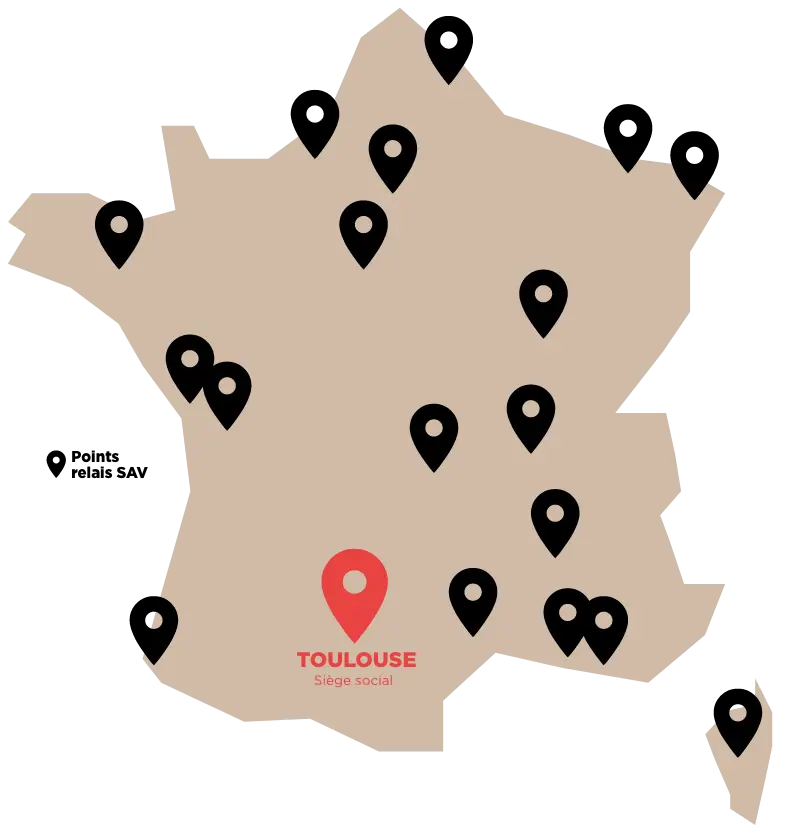
Battery issue, windshield replacement, charger malfunction, or doubt about the operation of an option? Nothing is more reassuring than knowing that a qualified technician can intervene quickly on-site, anywhere in France, without a wait of several weeks. At Subloisirs, our team of 10 mobile technicians We cover the entire country and guarantee rapid response times, ensuring your teams' mobility and your customers' comfort are never compromised. Our responsiveness makes all the difference—our clients attest to this every season.
Price, but also service: our vision of partnership
For us, a golf cart isn't just a product to be delivered: it's a promise of efficiency, an extension of your brand image, a comfort boost for your customers, and a productivity tool for your employees. We are committed to supporting our clients long-term, from model selection to on-site delivery, including regular maintenance, trade-in of old vehicles, customization with your establishment's colors, and comprehensive fleet management. This partnership approach—rather than a simple transaction—has made Subloisirs a trusted name among tourism professionals for over 15 years.
Why choose Subloisirs for your professional fleet?
- More than 15 years of experience in mobility equipment for tourism and leisure professionals.
- Permanent stock of new and refurbished golf carts (Club Car, EZGO, Yamaha) with personalized study.
- 10 mobile technicians for rapid intervention throughout France, all year round.
- Formulas purchase, leasing, long-term rental tailored to every budget and every season.
- Maintenance included in rental contracts, with no hidden fees during the season.
Official sources and references used in this guide:
- Legifrance – Article R311-1 of the Highway Code: definition of L6e and L7e quadricycles
- Legifrance – 2019 Consolidated Version of Article R311-1
- Legifrance – Article L211-1 of the Insurance Code: obligation to have liability insurance
- Legifrance – Insurance Code section: mandatory insurance for motor vehicles
- Legifrance – General provisions for traffic liability insurance
- Legifrance – Property and casualty insurance: general provisions
- Service-Public.fr – AM license (moped and light quadricycle)
- Dordogne Prefecture – Regulatory update on motorized quadricycles
- JMJ Group – Legal Environment of Electric Quadricycles
- MVCG France – Technical Data Sheet Article R311-1 of the Highway Code (PDF)
- EPlaque.fr – Official classification of category L vehicles
- CER Network – AM license training for light quadricycles (microcars)
- Alliance Auto – Regulatory Summary: Golf cart on the road
 French
  English
  Spanish