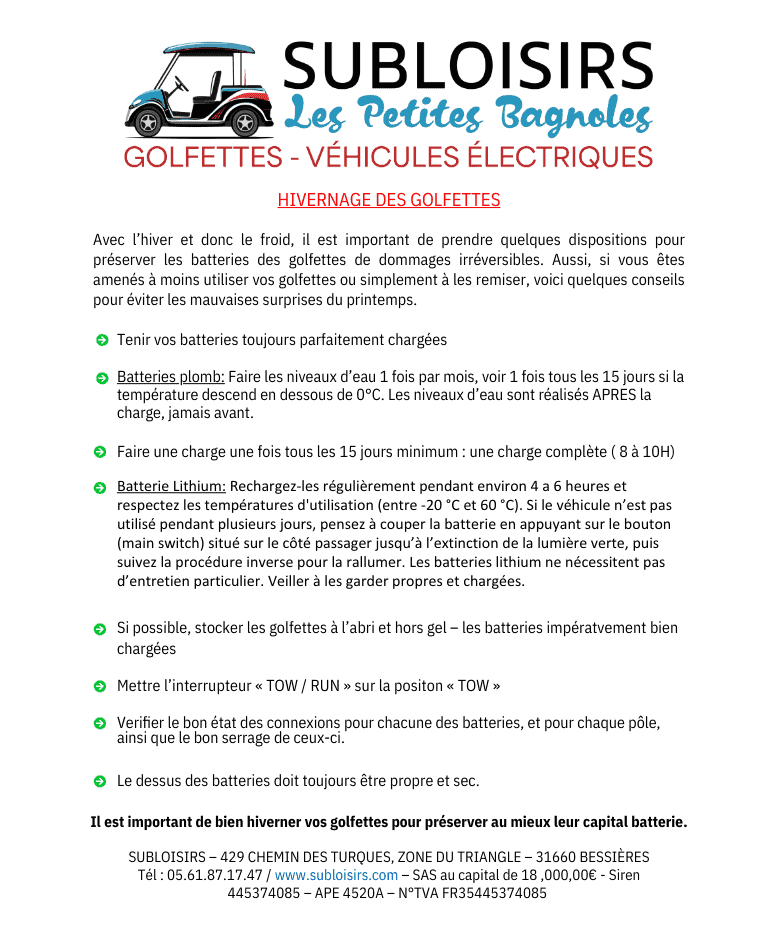
A golf cart is a compact electric or thermal vehicle, originally designed for golf courses, now used in campsites, private estates, industrial sites and even on public roads. To be driven on the road, it must be approved as a light quadricycle (L6e) or heavy quadricycle (L7e), to own a vehicle registration document and one Mandatory civil liability insurance. The driver must hold at least the AM license from age 14 (L6e) or the Category B1 driving licence from age 16 (L7e). The price of a new golf cart varies from €5,000 to €25,000 depending on the engine (electric or thermal) and the type of battery (Lead or Lithium-LiFePO4).
What is a golf cart? Definition and categories
From the golf cart to the multi-purpose utility vehicle
Originally, the term "golfer" referred to the small, open-topped golf cart seen on the greens. Its initial purpose was simple: to transport one or two players and their equipment around a golf course. But for the past fifteen years or so, this compact vehicle has expanded far beyond its traditional playing field.
Today, golf carts can be found in a wide variety of contexts: campsites and holiday villages, Vineyards, industrial sites, airports, gated communities, and local authorities are all examples of their versatility. Their compact size, quiet operation (in the electric version), and ease of use make them an extremely versatile tool for sustainable mobility.
In practical terms, a golf cart can be available in 2-seater, 4-seater, 6-seater, utility flatbed, tipper truck, or even mini-ambulance versions for sporting events. They are no longer simply "golf carts" but genuine... electric utility vehicles in its own right.
Electric vs. Thermal: The Great Duel
The choice between an electric golf cart and a petrol golf cart depends mainly on your use, your terrain and your operating budget.
| Criteria | Electric Golf | Petrol Golf Cart |
|---|---|---|
| Autonomy | 40 to 80 km (Lithium) / 30 to 50 km (Lead) | 150 to 250 km per tank |
| Charging cost / fuel | €0.50 to €1.50 per full top-up | €5 to €8 per fill-up |
| Noise pollution | Virtually silent (< 50 dB) | Noticeable engine noise (65-75 dB) |
| Interview | Low (no oil change, few moving parts) | Regular maintenance (oil change, filter, spark plug, belt) |
| Torque/Power on Hills | Immediate couple, good on a gentle slope | Superior on very hilly terrain |
| Environmental impact | Zero local emissions | CO₂ and particulate emissions |
| Average lifespan | 15 to 25 years (excluding batteries) | 10 to 20 years |
| New purchase price (indicative) | €6,000 to €25,000 | €5,000 to €15,000 |
Subloisirs Advice: For use in camping, hotels, or on a flat golf course, the electric version is almost always the best choice. A combustion engine is only truly justified on very rugged terrain with long daily distances (farms, large forest estates).
Technical categories: non-homologated vs homologated (L6e / L7e)
This is where the confusion is most frequent. Not all golf carts are equal in the eyes of the law. Two main categories exist:
1. The golf cart not approved for road use This is the classic golf course model. It has no registration papers, no regulation headlights, and no turn signals. Its use is strictly limited to private land : golf courses, campsites, gated estates. It cannot under any circumstances use the public road, even to cross a departmental road between two plots.
2. The road-legal golf cart : it is classified by the Highway Code (Article R311-1) like a motorized quadricycle. Two subcategories can be distinguished:
| Category | L6e – Light Quadricycle | L7e – Heavy Quadricycle |
|---|---|---|
| Maximum unladen weight. | 425 kg (excluding batteries) | 450 kg (passengers) / 600 kg (goods) |
| Maximum speed. | 45 km/h | Above 45 km/h (variable) |
| Maximum power. | 6 kW (≈ 8 hp) | 15 kW (≈ 20 hp) |
| Permit required | AM license (from 14 years old) or B license | Category B1 license (from age 16) or Category B license |
| Vehicle registration document | Mandatory | Mandatory |
| Vehicle inspection | No (for the moment) | Yes |
Alert : Buying a golf cart that isn't road-legal in the hope of getting it certified later is a very risky gamble. The procedure for road compliance It requires specific equipment (lights, mirrors, seat belts, windshield) and approval from the DREAL (Regional Directorate for the Environment, Planning and Housing). The cost can exceed that of the vehicle itself.
Technical anatomy: how does a golf cart work?
Batteries: Lead vs Lithium (lifespan, maintenance, cost)
The battery is the most strategic component of an electric golf cart. It determines the vehicle's range, weight, lifespan, and total cost of ownership. Two technologies dominate the market.
Did you know that? To understand how a battery works, imagine a plumbing system. The voltage (V) This corresponds to the water pressure in the pipe: the higher the pressure, the stronger the flow rate.’ampere-hour (Ah) This corresponds to the tank's volume: the larger it is, the longer you can water. A 48V 150Ah battery pack therefore offers high pressure and a large energy reserve.
| Criteria | Lead-acid battery (AGM / Trojan) | Lithium battery (LiFePO4) |
|---|---|---|
| Lifetime | 3 to 5 years / 500 to 800 cycles | 8 to 12 years / 2,000 to 5,000 cycles |
| Weight (48V pack) | ≈ 180 to 250 kg | ≈ 40 to 60 kg |
| Charging time | 8 to 12 hours | 2 to 4 hours |
| Recommended discharge depth | 50 % max. (otherwise damage may occur) | 80 to 90 % without damage |
| Interview | Distilled water level, terminal cleaning, equalization | Almost nothing |
| Sensitivity to cold | Significant (capacity loss from 5°C) | Moderate (integrated BMS manages the temperature) |
| Price of the pack (48V) | €800 to €1,500 | €2,500 to €5,000 |
| Total Cost of Ownership (TCO) | €1.50 to €2.50 / cycle | €0.50 to €1.00 / cycle |
Technology LiFePO4 (Lithium Iron Phosphate) is now the standard for professional golf carts. Despite a higher initial investment, the total cost of ownership over 10 years is significantly lower than Lead, not to mention the considerable weight saving (up to 200 kg less) which reduces wear on the running gear, brakes and tires.
Danger – Deep dump: Regularly letting a lead-acid battery's charge drop below 50 % drastically reduces its lifespan. This is the number one cause of premature battery replacement. If you forget to recharge your lead-acid golf cart for several weeks, the damage can be irreversible (plate sulfation).
The motor and the controller: the heart of the system
The motor of an electric golf cart is usually a direct current (DC) motor or, on newer models, an alternating current (AC) motor. The AC motor offers better efficiency, regenerative braking, and a longer lifespan, but at a higher cost.
THE speed controller The electronic control unit (also called the electronic dimmer) is the "brain" of the vehicle. It regulates the amount of power sent from the battery to the engine based on the accelerator pedal position. A poorly adjusted or faulty controller can cause jerking, excessive energy consumption, or a loss of power when going uphill. It is a technical component that requires specialized diagnostics in case of failure.
Chassis and running gear: wear points to monitor
The chassis of a golf cart is generally made of steel or aluminum (on high-end models like some Club Cars). The most frequent wear points to monitor are:
THE steering silent blocks and ball joints Constantly subjected to stress on uneven terrain, they generate play in the direction and unpredictable behavior. shock absorbers and leaf springs On utility models that are frequently loaded, their wear is rapid. drum or disc brakes Their wear depends on the terrain profile (high stress on descents). Finally, the tires : underinflated tires increase electrical consumption by 10 to 15 % and accelerate bearing wear.
Advice : Check your golf cart's tire pressure at least once a month. It's the simplest and most cost-effective maintenance task: it extends the driving range, preserves the batteries, and reduces mechanical wear.
Regulations 2026: Where and how are you allowed to drive?
This is the most sensitive part of this guide. The regulations surrounding golf carts are a source of many misconceptions, This includes the idea that it would be a vehicle "without a license" or "without insurance". In 2026, the obligations are clear and the penalties are real.
On private land (campsite, golf course, property): what are the rules?
On strictly private land not open to public traffic (your property, a fenced golf course), the rules of the Highway Code do not directly apply. You do not need a registration certificate or a driver's license to drive an unregistered golf cart.
However, be aware: a campsite or holiday village, even a private one, is a «"Private land open to the public"». This legal nuance is fundamental. In the event of a personal injury accident involving a customer or a pedestrian, the operator is liable, and the lack of insurance constitutes an aggravating fault.
Legal obligation: L'’Article L211-1 of the Insurance Code requires liability insurance for any motorized land vehicle, Even if it's only driven in your garden, driving without insurance exposes you to a fixed penalty of €750 (which can amount to up to €3,750 in court) and to the vehicle confiscation.
On public roads: registration and mandatory equipment
To legally drive on a road open to traffic, A golf cart must absolutely be certified. in category L6e or L7e. This implies a set of obligations:
Registration and vehicle registration document : the vehicle must have a European certificate of conformity and be registered in the prefecture (or via the ANTS). Required equipment : front and rear lights, turn signals, mirrors, horn, windshield, seat belts and license plate. Mandatory liability insurance : with a valid green card affixed to the vehicle. Finally, for L7e models, a periodic technical inspection is required.
Alert – Speed limit: A golf cart approved for category L6e is speed limit of 45 km/h. Therefore, it cannot use expressways, highways, or roads with a higher minimum speed limit. Find out more about the local traffic restrictions before any purchase for road use.
Which license for which driver?
Contrary to a widespread misconception, driving a golf cart on public roads requires a license. The type of license depends on the vehicle category:
| Vehicle category | Permit required | Minimum age | Terms |
|---|---|---|---|
| L6e (light quadricycle) | AM license (ex-BSR) or B license | 14 years old | 8-hour driving school training course |
| L7e (heavy quadricycle) | B1 license or B license | 16 years old | Theoretical and practical exam |
| Not approved (private property) | No permit required | No legal minimum | For strictly private use only |
People born before January 1, 1988 are exempt from the AM license to drive a light quadricycle L6e. For people born after this date, the An AM licence is essential, even if they already have a B licence (which in fact includes category AM).
Civil liability insurance: an absolute obligation (Badinter Law)
This point deserves to be emphasized because it is consistently underestimated.’Civil liability insurance is mandatory for any golf cart, without exception: whether it is driven on the road, in a campsite, on a golf course or on private property.
There Badinter Law (1985) It protects victims of traffic accidents involving a motor vehicle. Without insurance, in the event of bodily injury, the owner will have to compensate the victim from their own funds — the amounts can reach hundreds of thousands of euros in the case of serious injuries.
Good news: The cost of insuring a golf cart is relatively modest. Expect to pay between €100 and €300 per year Basic liability insurance costs between €300 and €600 per year, while comprehensive coverage including theft and damage costs between €300 and €600 per year. This is a negligible investment compared to the financial risk incurred without insurance.
Buying and making a profit: the keys to investing wisely
New or refurbished used?
The used golf cart market is dynamic, particularly due to the regular renewal of golf and campground fleets. A refurbished brand-name model (Club Car, EZ-GO, Yamaha) can represent a saving of 40 to 60 % compared to new.
However, buying used has its pitfalls. The number one thing to watch out for is the condition of the batteries: a set of lead-acid batteries at the end of their life (3-5 years) can cost between €800 and €1,500 to replace, negating any savings. Also check the condition of the speed controller, chassis corrosion (especially in coastal areas), and the wear on the running gear.
Advice : Before buying anything second-hand, ask for a battery capacity test (not simply a voltage test). A battery pack can show 48V unloaded and drop to 38V under load. Only a load test reveals the true state of the cells.
Business taxation 2026: depreciation and VAT (Focus Pro)
For professionals (campsites, golf courses, local authorities, businesses), purchasing a golf cart represents a depreciable investment. In 2026, the tax conditions are as follows:
Depreciation An electric golf cart can be depreciated over 4 to 7 years depending on the company's accounting policy. Lithium batteries, if billed separately, can be depreciated separately over their own lifespan (8-12 years). VAT VAT is 100% recoverable for a commercial vehicle (flatbed, tipper) used for business purposes. For vehicles classified as "passenger transport," recovery depends on the use and status (public passenger transport or not). Finally, regarding the«charging electricity, VAT is recoverable on business expenses.
Attention – Eco-bonus 2026: THE ecological bonus for electric quadricycles The subsidy was significantly reduced and then eliminated during 2025. In 2026, there is no longer a specific purchase incentive for new electric golf carts nationwide. However, check local aid programs (Regions, Metropolitan Areas) which may still offer subsidies.
The cost of daily charging and maintenance
One of the major advantages of the electric golf cart is its extremely low operating costs compared to a conventional internal combustion engine vehicle.
| Expenditure item | Electric Golf (Lithium) | Electric Golf (Lead-acid) |
|---|---|---|
| Recharge (per complete cycle) | €0.50 to €1.00 | €0.80 to €1.50 |
| Annual energy cost (daily use) | €150 to €300 | €250 to €450 |
| Annual mechanical maintenance | €100 to €200 | €150 to €300 (+ distilled water) |
| Battery replacement (amortized/year) | €250 to €500 per year | €200 to €400 per year |
| Estimated total annual cost | €500 to €1,000 | €600 to €1,150 |
For a daily professional use, The Lithium electric golf cart costs approximately €2 to €3 per day all inclusive (energy + maintenance + battery depreciation). It is one of the most economical motorized means of transport on the market.
Subloisirs: your technical expert for purchase and maintenance
Understanding the theory is one thing, choosing the right vehicle is another. At Subloisirs, For over 15 years, we have been transforming this technical expertise into concrete solutions for our clients.
Why choose Subloisirs for your project?
Neutral technical advice: Thermal or electric? Lead or Lithium? We analyze your terrain (slopes, distances, frequency of use) to recommend the truly suitable motorization, without pushing for overconsumption.
Regulatory control: We guide you through the administrative maze. Vehicle registration document, certificate of conformity, license plates: all our road-legal vehicles are delivered «"Turnkey"» and in accordance with regulations.
Specialized workshop: A golf cart is a complex machine. Our 10 mobile technicians are trained to work on electronic speed controllers and charging systems of all major brands (Club Car, EZ-GO, Yamaha), guaranteeing the longevity of your investment.
You understand everything about the golf cart, but you still have one question? Contact our experts for a personalized assessment of your needs.
Frequently Asked Questions about Golf Carts (FAQ)
Do you need a license to drive a golf cart?
Yes, if you are driving on public roads. A golf cart approved under category L6e (light quadricycle, max. 45 km/h) requires the AM license from age 14 or a category B driving licence. A golf cart L7e (heavy quadricycle) requires the Category B1 driving licence from age 16 or a category B license. However, on strictly private land (property, fenced golf course), no license is required. People born before January 1, 1988, are exempt from the AM license to drive an L6e.
Can you drive a golf cart on the road?
Yes, provided it is road-legal. in category L6e or L7e. She must possess a vehicle registration document, A golf cart (L6e) must have third-party liability insurance, regulation lights, turn signals, mirrors, a horn, and seat belts. It is limited to 45 km/h and cannot use expressways or highways. An unregistered golf cart cannot be driven on public roads under any circumstances.
Should you insure a golf cart even on private land?
Yes, it's a legal obligation. Article L211-1 of the Insurance Code mandates Civil Liability insurance for any motorized land vehicle, including those driven exclusively on private land. Driving without insurance is punishable by a fine of €750 to €3,750 and the confiscation of the vehicle. The cost of third-party liability insurance for a golf cart is modest: between €100 and €300 per year.
What is the difference between an L6e and an L7e golf cart?
The category L6e (light quadricycle) It is limited to 45 km/h, 6 kW of power and 425 kg unladen. It is available from 14 years old with an AM license. The category L7e (heavy quadricycle) exceeds 45 km/h, can reach 15 kW and weigh up to 600 kg. It requires the Category B1 driving licence from age 16. The L7e is subject to periodic technical inspection, unlike the L6e.
Lead or Lithium battery for a golf cart: which to choose?
There Lithium LiFePO4 battery is superior on almost all criteria: lifespan of 8 to 12 years (vs. 3-5 years for lead-acid), reduced weight of 60 to 70 g (%), recharge time of 2-4 hours (vs. 8-12 hours), virtually no maintenance, and cost per cycle half as much. Its only drawback is the higher initial purchase price (€2,500 to €5,000 vs. €800 to €1,500 for Lead). For daily professional use, Lithium pays for itself in 2 to 3 years.
What is the price of a new golf cart in 2026?
The price of a new golf cart varies from €5,000 to €25,000 depending on the motor, battery capacity and type. A 2-seater electric golf cart with lead-acid batteries starts at around 6 000 €. A road-legal 4-seater model with lithium batteries is priced between €12,000 and €20,000. High-end utility versions (Club Car, EZ-GO) can reach €25,000. For a refurbished used model, expect to pay... 40 to 60 % less.
What is the range of an electric golf cart?
With Lithium batteries, a golf cart travels on average 40 to 80 km per charge. With Lead-acid batteries, autonomy lies between 30 and 50 km. These figures vary depending on the weight carried, the elevation change, and the outside temperature (cold significantly reduces the capacity of lead-acid batteries). The cost of a full recharge is €0.50 to €1.50.
Is there an ecological bonus for buying a golf cart in 2026?
No, not at the national level anymore. The ecological bonus for electric quadricycles was gradually reduced and then eliminated during 2025. In 2026, there was no longer a national purchase incentive for new electric golf carts. However, some local authorities (Regions, Metropolitan Areas) still offer assistance. Check with your regional or inter-municipal authority before making any purchase.
How do I maintain an electric golf cart?
Each month : check tire pressure and battery charge status. Every 6 months Inspect the brakes, bushings, and electrical connections. For the Lead-acid batteries Check the distilled water level and clean the terminals. For the Lithium batteries Maintenance is virtually nonexistent thanks to the integrated BMS. Avoid leaving a lead-acid golf cart uncharged for more than 48 hours to prevent irreversible sulfation of the plates.
Can a golf cart be registered for road use?
It's technically possible but very expensive. Bringing the vehicle into compliance requires the addition of lights, turn signals, mirrors, a windshield, seat belts, and a license plate, followed by... validation by DREAL. The total cost may exceed the price of the vehicle. It is generally more advantageous to buy a road-legal model directly from a specialist like Subloisirs.
Sources and references for this article:
Legislative sources:
• Article R311-1 of the Highway Code – Legal definition of categories of motorized quadricycles (L6e / L7e).
• Article L211-1 of the Insurance Code – Mandatory civil liability insurance for all motorized land vehicles.
Specialized sources:
• Subloisirs – Driving a golf cart
• Subloisirs – Using a golf cart on the road
• The Auto Blog – Driving a golf cart on the road
• Luxury Car Sales – Golf Cart Insurance
• Yellow Pages – Golf Cart Guide
 French
  English
  Spanish